
1. Introduction
Carbon fiber, glass fiber, and aramid fiber are the three most widely used reinforcement fibers in the composites industry. They all sit inside “fiber-reinforced plastics,” yet their prices differ by several times to more than ten times, and their performance profiles point in completely different directions. Choose wrong and you either fail to meet the performance target or blow far past your budget. This article builds a practical selection framework from three angles: material data, typical applications, and a step-by-step decision process.
2. Quick Overview of the Three Fibers
2.1 Carbon Fiber
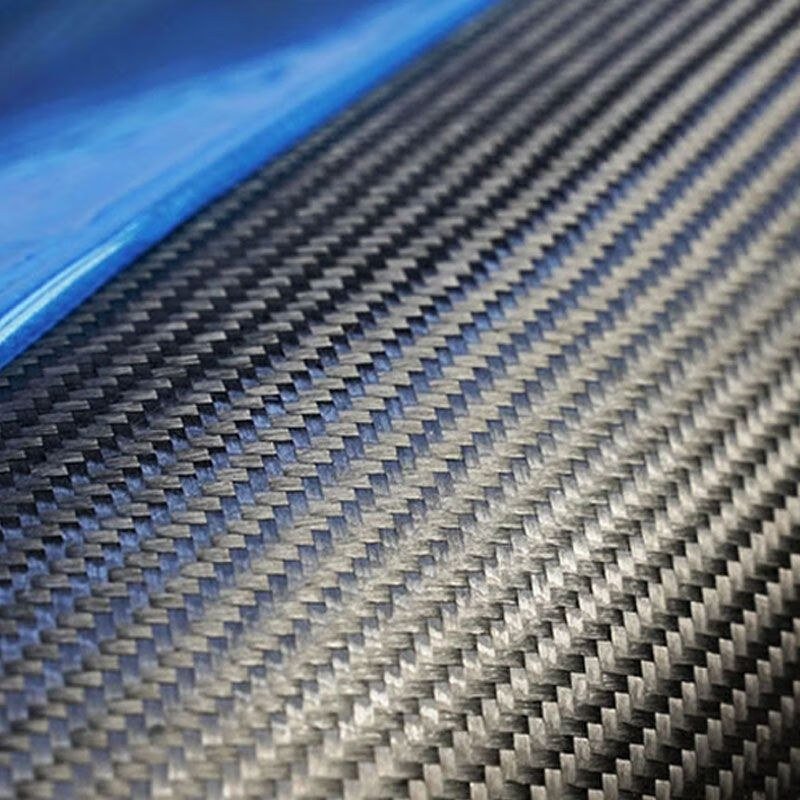
PAN-based (polyacrylonitrile) carbon fiber is the mainstream. Its density is only about 1.78 g/cm³, tensile strength 3500–4000 MPa, and tensile modulus up to 230 GPa and above — the best combination of light weight, strength, and stiffness among all reinforcements. The trade-offs: it is electrically conductive, has a low elongation at break (about 1.5%), and costs more. It suits applications with demanding weight and stiffness requirements.
2.2 Glass Fiber
E-glass is the most widely used type by volume. Density is about 2.55 g/cm³, tensile strength 3100–3800 MPa, and tensile modulus 72–76 GPa. It offers the lowest cost, good electrical insulation, and a balanced overall profile — the best value-for-money general-purpose reinforcement. When higher strength is needed, S-glass or high-strength glass is the upgrade path.
2.3 Aramid Fiber
Para-aramid (for example Kevlar 49) has a density of only about 1.44 g/cm³, tensile strength 2800–3000 MPa, and tensile modulus 112–131 GPa. Measured by specific strength (strength/density), aramid is the highest of the three. Its impact, cut, and abrasion resistance stand out. The caveats: compression strength is low and moisture absorption is relatively high — keep both in mind during selection.
3. Key Performance Comparison
Table 1 compares typical fiber-level properties; Table 2 compares them from an engineering/layup perspective.
| Property | E-Glass | S-Glass | Carbon (T300-class) | Aramid (Kevlar 49) |
|---|---|---|---|---|
| Density (g/cm³) | 2.55 | 2.49 | 1.78 | 1.44 |
| Tensile strength (MPa) | 3100–3800 | 4000–4600 | 3500–4000 | 2800–3000 |
| Tensile modulus (GPa) | 72–76 | 86–90 | 230 | 112–131 |
| Elongation at break (%) | 2.5–4.8 | 4.5–5.4 | 1.5 | 2.4–3.6 |
| Relative cost | Low | Medium | High | Medium-high |
Table 1. Typical properties of the three fibers (fiber level; typical values — confirm against manufacturer datasheets).
| Dimension | Carbon Fiber | Glass Fiber | Aramid Fiber |
|---|---|---|---|
| Specific stiffness (stiffness/density) | Highest | Low | Medium |
| Impact resistance | Medium (rather brittle) | Medium | Highest |
| Abrasion & cut resistance | Medium | Medium | Highest |
| Compression strength | High | Medium | Low (weak point) |
| Electrical performance | Conductive | Insulating | Insulating |
| Long-term heat resistance | High | Medium | Medium |
| Moisture absorption | Low | Medium | Higher |
| Cost | High | Lowest | Medium-high |
| Typical product forms | Fabric / UD tape / prepreg | Fabric / roving / mat | Fabric / UD tape |
Table 2. Engineering selection dimensions (fiber/layup level).
4. Choosing by Application
4.1 Structural & High-Stiffness — Carbon Fiber
Aerospace structures, high-end sports equipment (bicycles, rackets, fishing rods), drone fuselages, and robotic arms: when ultimate lightweighting and stiffness are the goal, carbon fiber is the first choice.
4.2 Cost-Sensitive & General Industry — Glass Fiber
Hulls, storage tanks, pipes, wind turbine blades, automotive interior and exterior parts, and structural strengthening: when the performance target is met at the lowest possible cost, glass fiber is the default. Upgrade to S-glass or high-strength glass when higher strength is required.
4.3 Impact, Abrasion & Protection — Aramid
Ballistic protection, cut-resistant gloves, conveyor belts, tire cords, racing boat hulls, and speaker cones: applications that must absorb impact energy or resist wear and cutting perform best with aramid.
4.4 Hybrid Solutions
Carbon + aramid (stiffness plus impact, e.g., protective helmets, racing hulls), carbon + glass (balancing stiffness and cost, e.g., certain automotive parts), and glass + aramid (low cost plus abrasion resistance) are common hybrid layups used to balance performance and budget.
5. Five-Step Selection Process
Step 1: Define the loads and failure modes — stiffness-controlled, strength-controlled, or impact-controlled?
Step 2: Set the weight and size constraints — is a thicker layup acceptable to make up for stiffness?
Step 3: Evaluate the service environment — temperature, humidity, chemical media, and electrical requirements.
Step 4: Calculate cost and process — fiber price, layup efficiency, tooling, and production cycle time.
Step 5: Validate with samples — verify performance with actual layup specimens, not just the fiber data sheet.
6. Common Misconceptions
Myth 1: “Carbon fiber is always better than glass fiber.” They target different performance profiles; cost-sensitive structures are often built more rationally with glass.
Myth 2: “Aramid has the highest strength.” Aramid’s tensile strength is lower than carbon’s. Its real advantages are specific strength and impact resistance; compression is its weak point.
Myth 3: “Fiber data equals part performance.” Fiber volume fraction, layup orientation, and resin system jointly determine final performance — unidirectional, fabric, and multi-axial layups differ enormously.
Myth 4: “You must pick one fiber.” Hybrid layups are often the optimal answer for both performance and cost.
7. Conclusion
There is no “best fiber,” only the “most suitable solution.” Carbon fiber wins on lightness and stiffness, glass fiber on cost and balance, and aramid on specific strength and impact resistance. Comparing all three in one framework is the way to make a decision that meets performance without breaking the budget.
LX Composites (Danyang Lixing Carbon Products Co., Ltd.) supplies carbon fiber fabrics, thermoplastic carbon fiber prepregs, continuous-fiber thermoplastic glass composites, and aramid fabrics, with custom specifications and sample validation supported. For selection advice or samples, contact us via the website form or email manager@lxcomposites.com.
Data note: values in the tables are typical industry figures compiled from public sources such as the FabFlow composites engineering guide, Texonic fiber property tables, and Journal of Chongqing University (2020). Actual performance should be confirmed against manufacturer datasheets and testing.
Related Reading
- Carbon Fiber Fabric Selection Guide — Choosing tow size, weave and weight
- Carbon Fiber Types & Classification — Understanding the carbon fiber family
Related Products
Carbon Fiber Fabrics · Glass Fiber Products · Aramid Fabrics
Have a specification to match? Send us the application and process through our contact page and we will confirm what we can supply.