
Pipe repair is one of the few composite applications where the material is chosen on site, handled by a crew under time pressure, and judged on whether the repair holds for the next twenty years. Glass fiber dominates this work for three reasons: it costs a fraction of carbon, its modulus is closer to steel and concrete so the repair shares load instead of delaminating, and it does not set up a galvanic couple with a steel host pipe.
What makes specifying difficult is that “glass fiber tape” describes at least four different products. The format you pick decides the repair method you can use.
Material formats used in repair work
| Format | Where it is used | What you must fix in the specification |
|---|---|---|
| Unidirectional glass tape | Filament-wound sleeves, wrap reinforcement, tape-laid liners | Width, thickness, fiber areal weight, matrix (thermoplastic or thermoset) |
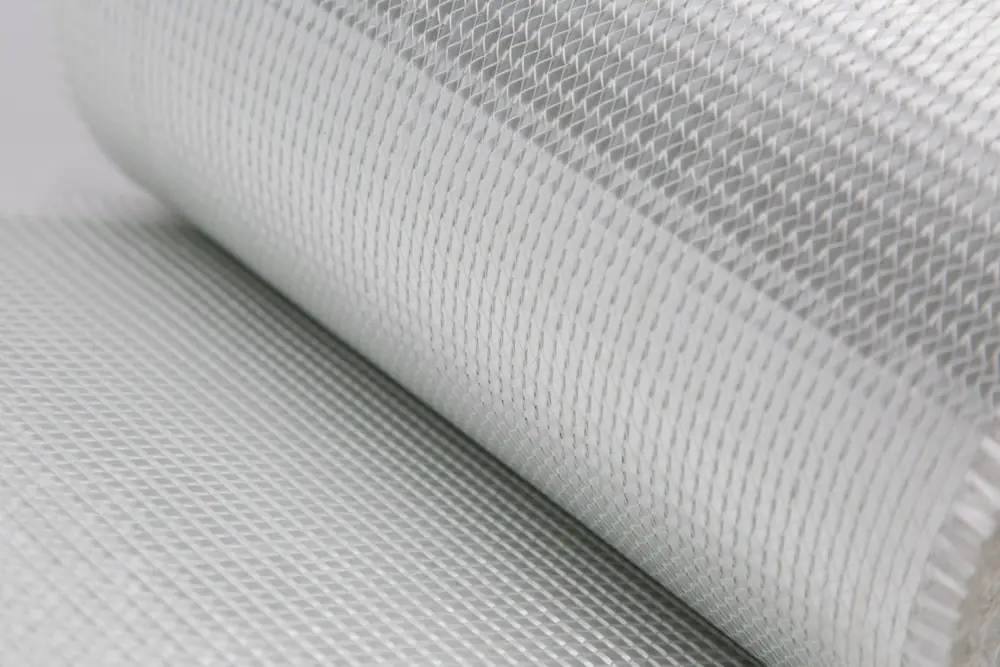
| Woven glass fabric | Hand lay-up patches, vacuum-infused overlays, joint wraps | Weave (plain or twill), areal weight in g/m², roll width |
| Woven roving | Thick build-up on large-diameter pipe, low-pressure work | Areal weight, weave openness, resin uptake |
| Roving | Filament winding of new liners and sleeves | Tex (yield), strand count, sizing compatibility |
The five parameters that decide the material
Almost every failed specification comes from leaving one of these five open. They are also the five things we ask for before quoting.
- Pipe diameter and repair length. These set tape width and the roll length needed per wrap. A 300 mm main and a 1200 mm trunk main do not use the same tape width, and the number of wraps changes the total length by a large factor.
- Host pipe material. Steel, cast iron, concrete and PE behave differently. Steel needs surface preparation to SA 2.5 before any wrap; concrete needs a different primer; PE usually needs a thermoplastic-compatible system because nothing bonds to it reliably.
- Repair method. A cured-in-place liner, an external wrap, a filament-wound sleeve and a structural overlay each impose different requirements on the reinforcement — thickness tolerance matters most for liners, conformability matters most for wraps.
- Resin system. Epoxy, vinyl ester and polyurethane each wet out glass differently, and the sizing on the glass has to match. If the site cannot handle wet lay-up, a thermoplastic matrix tape avoids the resin entirely.
- Pressure and temperature rating. This is what actually determines the laminate build-up — number of plies, orientation and total thickness. Fix the rating first, then work back to the material.
Glass or carbon for a repair laminate?
Carbon is stiffer, and for a repair that has to carry bending load over a long unsupported span that stiffness can matter. But three things usually push the decision back to glass: cost per unit of strength, the risk of a galvanic couple with a steel substrate, and the fact that a very stiff repair can concentrate stress at its termination instead of spreading it. Hybrid build-ups — glass at the interfaces, carbon in the primary load path — are common where both properties are needed.
Five specification mistakes that ruin a repair laminate
- Specifying “glass cloth” with no areal weight. 200 g/m² and 600 g/m² fabrics are both “glass cloth”, and they produce completely different ply thickness and resin demand.
- Ignoring sizing compatibility. Glass finished for epoxy does not wet out properly in a vinyl ester system. The laminate looks fine and tests badly.
- Skipping the CTE check on steel pipe. Steel expands far less than a glass laminate per degree. A rigidly bonded repair on a line that cycles in temperature accumulates shear at the ends.
- Underestimating overlap length. Overlap is where repairs fail. It is decided by the load to be transferred, not by the roll width you happen to have.
- No tolerances in the purchase order. Areal weight tolerance, width tolerance and roll length tolerance all need to be written down, or the second delivery will not match the first.
What we supply
We produce and supply glass reinforcement in the formats above, plus continuous glass fiber reinforced thermoplastic tape (GF/PP, GF/PA6, GF/PC, GF/PPS) in slit or full-width rolls for projects where wet lay-up is not practical. Woven glass fabrics run 50–600 g/m² and up to 1270 mm wide. Documentation available for a given grade includes COA, areal weight and width tolerances.
For the full material range see 玻璃纤维产品; for thermoplastic matrix options see 热塑性预浸料. If the project is still at specification stage, send the target pressure rating and we will propose a build-up rather than quote a roll.
Working on a pipe repair project?
Send the five parameters above — pipe diameter, host material, repair method, resin system and pressure rating — and we will come back with the matching glass format and an indicative build-up.